Anyone who has spent enough time building, modifying, or maintaining mechanical systems eventually discovers the value of standardization. A common interface allows products from different generations—and potentially different manufacturers—to work together without forcing the customer to start over every time something changes.
Computers have USB. Machine tools have standardized tapers and collets. Automotive components rely on countless agreed-upon dimensions and thread patterns.
The suppressor and firearm-accessory industries are no different.
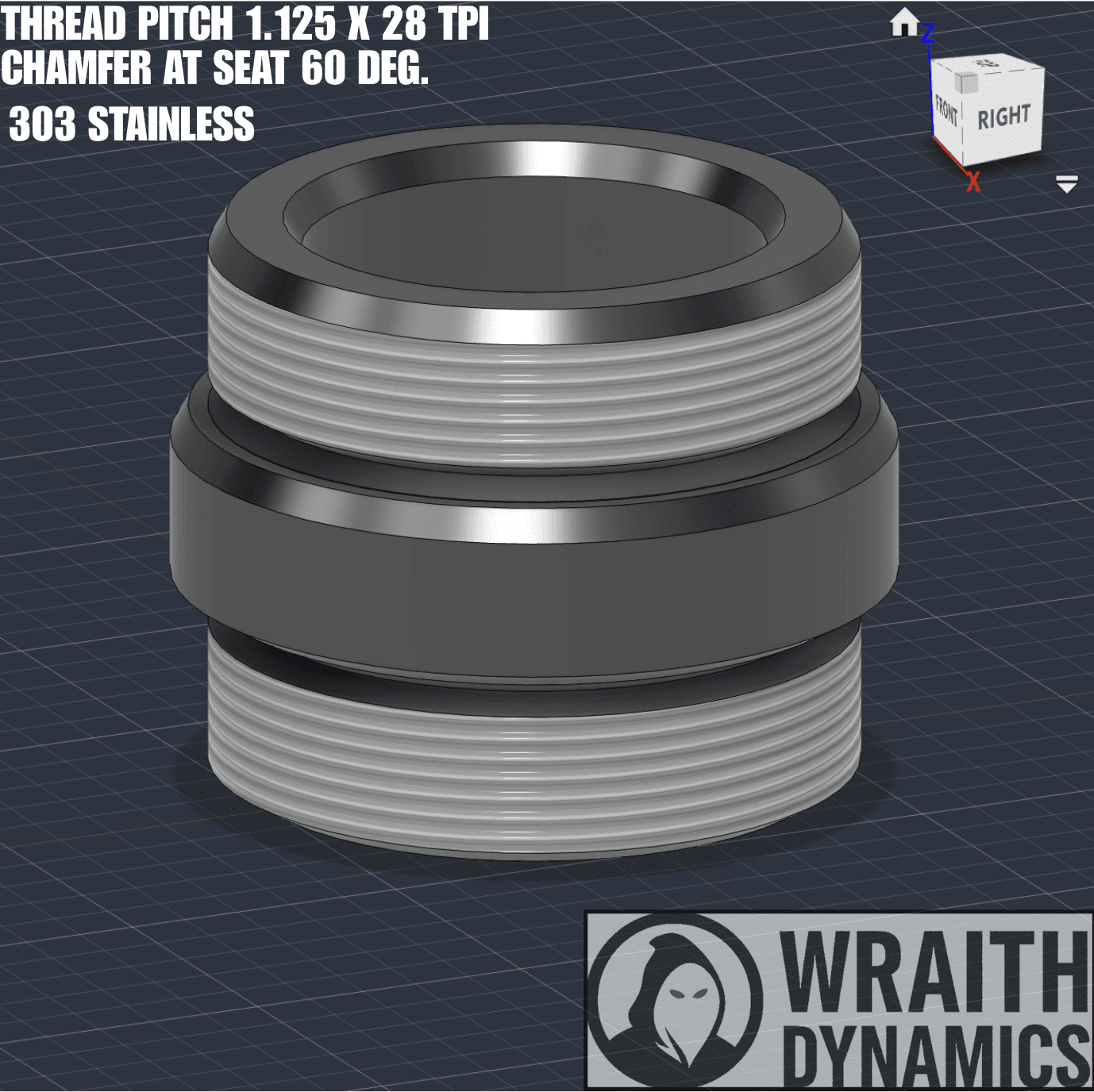
At WRAITH DYNAMICS, that philosophy is embodied in the Alpha HUB™ platform: a standardized 1.125 × 28 TPI interface around which we're building an expanding family of cross-compatible components.
BUILD THE INTERFACE, THEN BUILD THE ECOSYSTEM
One of the easiest mistakes for a manufacturer to make is designing every new product in isolation.
Product A gets one interface. Product B gets another. The next generation changes dimensions again. Before long, the manufacturer has created a catalog full of components that work perfectly well individually but poorly as a system.
Customers pay the price.
We prefer a different approach.
Where practical, WRAITH products are designed around a common Alpha HUB interface. GHOST, PHANTOM and SPECTER may use dramatically different materials and serve different roles, but the interface connecting compatible components remains familiar.
That means a builder doesn't necessarily have to abandon existing hardware simply because requirements change.
The product can evolve while the interface remains constant.
WHY CROSS-COMPATIBILITY MATTERS
Standardization creates something more valuable than convenience: choice.
A builder may initially prioritize low weight and select an aluminum component. Another may want the durability and heft of steel. Someone else may decide that titanium's combination of strength, weight and corrosion resistance justifies the premium.
Those shouldn't necessarily require three completely unrelated ecosystems.
That's the thinking behind WRAITH's material hierarchy:
GHOST — 6061-T6 aluminum
Lightweight, economical and accessible.
PHANTOM — steel
Durable, substantial and designed for customers who prioritize toughness.
SPECTER — titanium
Premium strength-to-weight performance for applications where material properties matter most.
Different materials solve different engineering problems.
A standardized interface allows those choices to coexist.
STANDARDS ARE BIGGER THAN BRANDS
There's another reason we're interested in standardized interfaces.
The best standards eventually become useful beyond the company that introduced them.
Builders routinely combine components from multiple sources. They modify existing equipment. They develop their own solutions. Small machine shops create specialized accessories that large manufacturers would never produce economically.
We think that's healthy.
A well-defined mechanical interface gives that creativity somewhere to begin.
Instead of asking a builder to remain inside a completely closed ecosystem, manufacturers can compete on the things that actually distinguish their products: materials, machining quality, weight, durability, design and price.
Compatibility becomes the baseline rather than the selling point.
PRECISION STILL MATTERS
Of course, sharing a nominal thread specification doesn't automatically make two components equivalent.
Thread quality matters.
Concentricity matters.
Seating geometry matters.
Material matters.
Inspection matters.
That's why WRAITH has continued investing in improved workholding, machining processes and inspection as the Alpha HUB family has expanded.
A standard establishes the language.
Manufacturing determines how well you speak it.
Our goal isn't merely to produce parts that nominally share dimensions. It's to produce components that assemble consistently and predictably within the platform for which they were designed.
A BETTER MODEL FOR BUILDERS
The word builder matters to us.
Builders don't necessarily want a manufacturer to make every decision for them. They want dependable building blocks.
Some want lightweight components.
Some want steel.
Some want titanium.
Some care primarily about cost. Others care about longevity, appearance, modularity or future upgrade paths.
Standardization lets manufacturers provide the foundation without dictating every eventual configuration.
That philosophy increasingly guides WRAITH product development.
Rather than asking:
“What complete product can we sell?”
we're increasingly asking:
“What useful component can we add to the platform?”
Adapters.
Caps.
Couplers.
Extensions.
Different materials.
Different configurations.
Each addition becomes more valuable when it works alongside components already in circulation.
THE NETWORK EFFECT OF HARDWARE
Software companies understand network effects intuitively: a platform becomes more useful as more people build around it.
Mechanical systems can behave similarly.
One compatible component is useful.
Ten compatible components create options.
A mature ecosystem creates possibilities the original designer may never have anticipated.
That is where standardized hardware becomes interesting.
A customer purchasing an Alpha HUB component today isn't simply choosing one piece of machined material. They're entering an ecosystem that we intend to continue developing.
And because the underlying interface remains stable, tomorrow's development doesn't necessarily make yesterday's hardware obsolete.
That's important to us.
WHERE WRAITH GOES FROM HERE
WRAITH DYNAMICS is still a young manufacturer, and Alpha HUB is still evolving.
That's precisely what makes this stage interesting.
We're talking directly with builders. We're seeing which configurations they request. We're watching which materials they prefer. We're learning which accessories solve real problems and which ideas merely sound clever on paper.
Those conversations increasingly influence what gets designed next.
As the regulatory and commercial environment surrounding suppressor technology continues to evolve, we believe standardized, modular architectures will become increasingly important. Manufacturers will have opportunities to rethink not only individual products, but how entire families of components interact throughout their service lives.
WRAITH intends to participate in that transition.
Not by creating the largest catalog possible.
Not by changing interfaces every time we develop something new.
But by building deliberately around a common foundation.
ONE STANDARD. MANY POSSIBILITIES.
GHOST.
PHANTOM.
SPECTER.
Different materials. Different priorities. A shared mechanical language.
That's the idea behind Alpha HUB™.
Because the most useful component isn't always the one that does everything.
Sometimes it's the one that lets everything else work together.
WRAITH DYNAMICS
ALPHA HUB™
Stay Silent. Hit Hard. Get Out Clean.™